
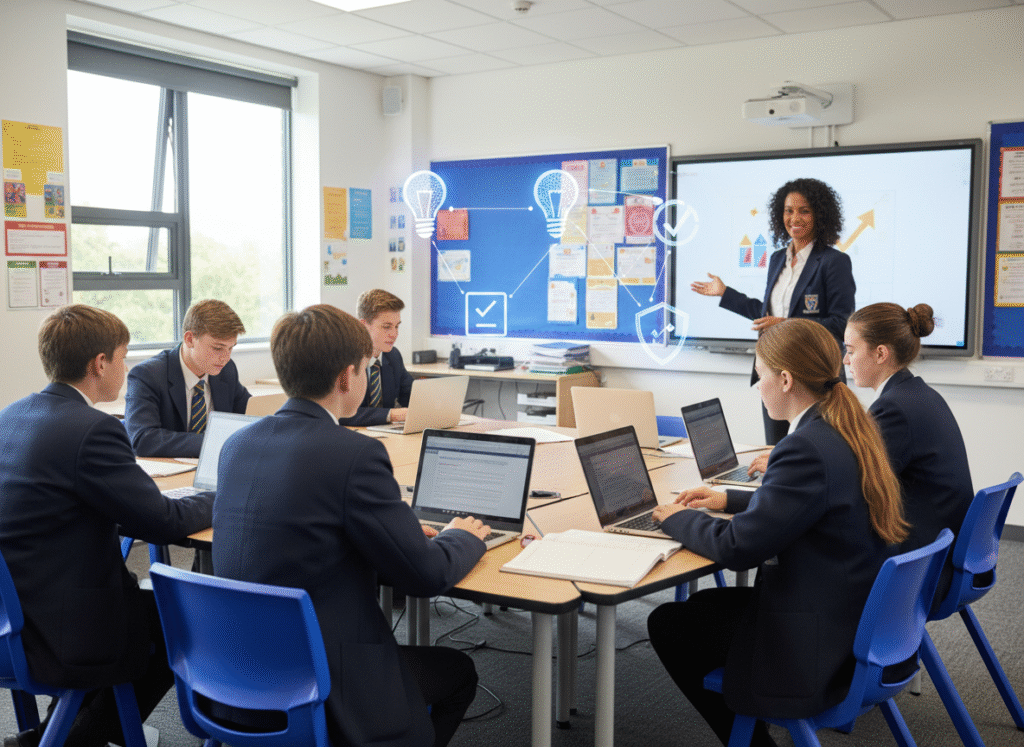
Artificial intelligence (AI) in education has moved from “interesting future tech” to something school leaders are having to address right now. The pace is being driven by widely available generative AI tools (the type that can create text, images and other content), alongside more established AI already built into everyday software.
For schools, the opportunity is clear: reduce workload, improve communication, personalise learning support, and make better use of data. The challenge is just as clear: safeguarding, data protection, bias, misinformation, academic integrity, and ensuring pupils learn how to use AI rather than simply relying on it.
As Peter Melville, Chief Operating Officer at SWECET Multi-Academy Trust, puts it: “It’s clear that AI or successor versions are here to stay and they potentially have the capacity to impact greatly on our way of life. In education, this is equally true.”
This guide looks at how AI has grown in education, how it is being used by teachers, support staff and pupils, and what schools can do to avoid being left behind.
What do we mean by “AI in schools”?
AI is a broad term. In schools, it usually falls into two categories:
- Generative AI: tools that can create content (for example, drafting text, generating quiz questions, summarising information, or creating images). The Department for Education (DfE) describes generative AI as technology that can create new content based on large volumes of data models have been trained on.
- Predictive and analytical AI: tools that spot patterns in data (for example, attendance trends, safeguarding flags, or forecasting). Many MIS and analytics tools already use elements of this.
Most of the current conversation in UK education is about generative AI, because it is accessible, fast, and can be used by staff and pupils with minimal training.
How AI has grown in education (and why it matters)
The last few years have seen a sharp increase in awareness and use of generative AI tools in education. Research from the National Literacy Trust shows teacher use of generative AI rose from 31% in 2023 to 47.7% in 2024. The same research programme surveyed tens of thousands of children and young people, reflecting how quickly AI has entered pupils’ day-to-day learning lives.
At the same time, DfE has published and updated national guidance on generative AI in education, emphasising that schools can choose their own use cases, but should prioritise safety, data privacy and professional judgement.
In practice, this means two things for school leaders:
- AI use is already happening, whether or not your school has a formal policy.
- The biggest risk is unmanaged use, where staff and pupils use tools inconsistently, without shared expectations.
How educators are using AI in the classroom
Teachers are using AI in ways that mirror where workload pressure is highest: planning, resourcing, differentiation and feedback.
1) Lesson planning and resource creation
AI can help staff:
- Draft lesson outlines and sequences
- Generate starter activities and exit tickets
- Create differentiated questions at different levels of challenge
- Produce model answers and explanations (which teachers then refine)
Used well, this can save time without lowering quality. Used poorly, it can create generic resources that do not match your curriculum intent.
A practical approach is to treat AI as a first draft assistant, not a final author.
2) Differentiation and suitable challenge
One of the most valuable uses is quickly creating:
- Simplified explanations for pupils who need extra support
- Stretch questions and extension tasks for high attainers
- Alternative examples that match different contexts
The key is ensuring AI supports teacher judgement, not replacing it. Schools that do this well build simple prompts aligned to their curriculum and expectations.
3) Feedback, marking support and next steps
Many teachers are exploring AI to:
- Suggest success criteria and common misconceptions
- Draft feedback comments based on a rubric
- Create “next step” targets
DfE notes that evidence is still emerging, and that teacher-facing use cases often bring more immediate benefits and fewer risks than pupil-facing use.
How back-office school staff are using AI
AI is not only for teaching. In many schools, the quickest wins are in the business and operational side.
1) Communications and admin
School leaders and office teams are using AI to:
- Draft parent letters and newsletters
- Summarise long documents into key points
- Create meeting agendas and minutes templates
- Rewrite communications in clearer, more accessible language
This can reduce time spent on repetitive writing and help maintain a consistent tone.
2) Policy and compliance support (with human oversight)
AI can help draft and structure:
- Policy templates
- Risk assessment checklists
- Staff briefing notes
However, schools should be cautious: policies must reflect your setting, and AI outputs can be inaccurate or outdated. The final responsibility still sits with the school.
3) Data, reporting and planning
Where schools have the right tools and permissions in place, AI can support:
- Trend spotting (attendance, behaviour, progress)
- Turning data into plain-English summaries for governors
- Creating “what changed since last term?” reports
This is where AI can save both time and money, by reducing manual reporting effort and helping leaders focus on action.
Peter Melville describes this broad, operational opportunity clearly: “All Trusts will be looking at ways to grasp the AI advantages and tackle areas of work processes that take time, require significant data processing or make learning and teaching more productive and enjoyable.”
How children and students are using AI (and how capable they are)
Pupils are often ahead of adults in experimenting with new tools. Many are already using AI for:
- Generating ideas for writing
- Revising and self-quizzing
- Summarising topics
- Improving spelling, grammar and clarity
The National Literacy Trust’s research indicates young people’s attitudes to using generative AI to support learning and literacy are generally positive.
The challenge for schools is not simply “stopping” AI use. It is teaching pupils:
- How to use AI to support thinking, not replace it
- How to check accuracy and avoid misinformation
- How to reference sources and avoid plagiarism
- How to protect personal data
If schools do not teach these skills explicitly, pupils will still use AI, but without the critical thinking and ethical framework they need.
Ethics, safeguarding and data privacy: what schools need in place
DfE’s guidance is clear that safety should be the top priority, and schools should consider their legal responsibilities, including data protection and safeguarding.
Peter Melville captures the balance many leaders are aiming for: “I like to think of AI as a useful tech ally but also, like many others, wary of new technologies and the need for guard rails.”
Key actions for schools include:
- Create a clear AI policy for staff and pupils (what is allowed, what is not, and why)
- Update homework and assessment guidance so expectations are explicit
- Train staff on safe use, prompt quality, and checking outputs
- Engage parents so they understand how AI is being used
- Avoid entering personal data into public AI tools unless you have a compliant, approved system
For many schools, the simplest starting point is a policy that separates:
- Teacher-facing use (planning, drafting, admin support)
- Pupil-facing use (supervised classroom tasks, explicit teaching of AI literacy)
How AI can save teachers time and energy (without lowering standards)
AI saves time when it reduces repetitive work. The biggest workload wins tend to come from:
- Drafting resources and adapting them for different groups
- Creating question banks and retrieval practice
- Turning notes into parent communications
- Summarising research and guidance into practical actions
A useful rule is: use AI to speed up the “blank page” stage, then apply professional judgement to ensure it is accurate, inclusive and aligned to your curriculum.
How AI can save schools time and money
Budget pressure means schools need to be realistic: AI should not be adopted because it is fashionable, but because it is useful.
Potential cost-saving areas include:
- Reduced time spent on admin and communications
- More efficient procurement and supplier comparisons (where tools support this)
- Better use of data for planning interventions (reducing waste)
- Improved consistency and quality in documentation
There is also a longer-term financial consideration: if AI literacy becomes a core skill, schools that build it into teaching and learning may be better placed to support pupil outcomes and destinations.
How suppliers are using AI (and what this means for schools)
School suppliers are increasingly embedding AI into products and services, even when they are not marketed as “AI tools”. This can benefit schools in two ways:
- Better products for the same price (for example, smarter reporting, automated insights, improved accessibility)
- Lower delivery costs, which can reduce prices over time
Examples of where suppliers may be using AI include:
- Edtech platforms that personalise practice questions
- Communication tools that summarise and triage messages
- Facilities and estates tools that predict maintenance needs
- HR and finance tools that automate routine workflows
Peter Melville highlights how wide the use cases can be when AI is treated as a partner: “My Trust is no different. We look at how we can incorporate new ways of working with AI as our partner not a competitor. Whether that’s website checking, marketing, lesson planning or financial monitoring; there are so many avenues to explore.”
For school procurement teams, this means asking better questions during evaluation:
- What data is used, and where is it stored?
- Can the supplier explain how bias is managed?
- What safeguarding and filtering controls exist?
- Can the school opt out of data being used to train models?
- What evidence is there of impact on workload or outcomes?
What schools should do now: a practical “don’t get left behind” checklist
Schools do not need to do everything at once. A phased approach is often safest.
Step 1: Agree your position
- Define what “good use” looks like in your setting
- Decide where AI is allowed (and where it is not)
- Identify quick wins that reduce workload
Step 2: Build staff confidence
- Provide training on prompting, checking outputs and bias
- Share example prompts aligned to your curriculum n- Create a simple approval process for new tools
Step 3: Teach pupils AI literacy and ethics
- Teach how AI works at an age-appropriate level
- Teach critical evaluation: accuracy, bias, hallucinations (made-up outputs)
- Teach academic integrity: when AI support is acceptable
- Teach data privacy: what should never be entered
Step 4: Put governance in place
- Update safeguarding, filtering and monitoring considerations
- Review data protection and DPIA processes where needed
- Keep a record of approved tools and use cases
Step 5: Review and improve
- Gather staff feedback on time saved
- Monitor pupil use and misconceptions
- Update policy termly as tools change
Peter Melville’s point about maturity is worth keeping in mind as you plan: “But we are only at the start of our journey. We are still establishing how our AI use will be for years to come, how students will embrace this and how our new found ways and solutions will only look like baby steps in years to come despite looking hugely significant today.”
Useful guidance and further reading
If you want to explore national guidance and research, these are good starting points:
- The DfE’s guidance on generative AI in education: https://www.gov.uk/government/publications/generative-artificial-intelligence-in-education/generative-artificial-intelligence-ai-in-education
- National Literacy Trust research on children, young people and teachers’ use of generative AI (2024): https://literacytrust.org.uk/research-services/research-reports/children-young-people-and-teachers-use-of-generative-ai-to-support-literacy-in-2024/
Final thoughts
AI in education is not a single product you buy. It is a capability schools build: staff confidence, pupil AI literacy, safe processes, and smart procurement.
Schools that act early do not need to be “perfect” — they need to be intentional. With clear expectations, training, and a focus on ethics and safeguarding, AI can help schools protect teacher time, improve consistency, and ensure pupils develop the skills they will need for the world of work.
Recommended Reading
How UK schools save money with collaborative purchasing
Navigating School Procurement Compliance: A Practical Guide for School Leaders