
Part of: Summer Works in Schools Procurement Hub – Summer Works in Schools: Timeline, Procurement Checklist & Trusted Suppliers | Incensu
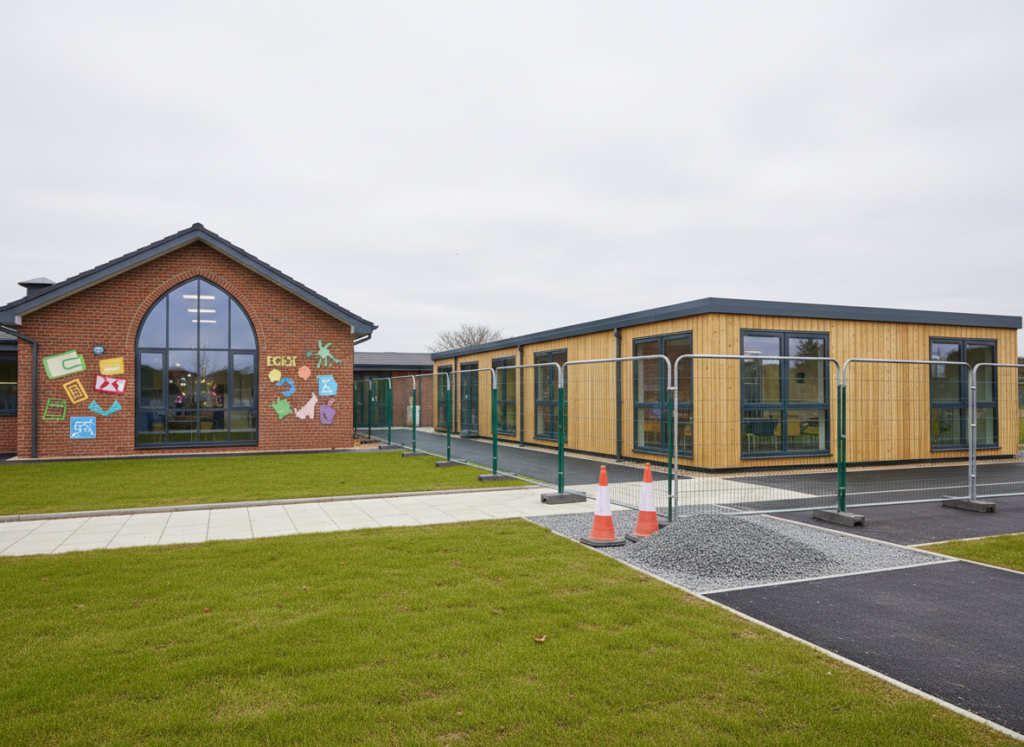
Modular school construction timeline (typical UK lead times)
Modular buildings for schools or temporary classrooms can be a practical way to add teaching space quickly, create decant accommodation during refurbishment, or expand provision without the disruption of a long on-site build.
But “quick” doesn’t mean “instant”. The biggest risk schools run into is leaving decisions too late and then discovering that manufacturing slots, surveys, planning, groundworks, utilities or delivery access push the programme back.
This guide explains what drives lead times, what to confirm early, and how to procure a modular classroom or block in a way that protects safeguarding, budget and reopening deadlines.
- Initial enquiry & requirements (1–5 working days)
Confirm what you need (number of classrooms, toilets, staff space, storage), preferred dates, budget range, and whether it’s a temporary or longer-term solution. - Site visit / survey (3–10 working days)
A supplier or contractor checks access for delivery vehicles/cranes, available space, levels, drainage, and where services can connect. - Specification, design & quotation (1–3 weeks)
You’ll agree room sizes, layout, finishes, safeguarding requirements, heating/ventilation, and any DDA/access needs. This is also where costs firm up. - Compliance checks & approvals (1–6+ weeks, depending on site and scope)
This may include checks around fire safety, asbestos (if near existing buildings), safeguarding, and any approvals required by your trust/LA. Some projects also need planning input. - Groundworks & foundation pads (1–3 weeks)
The site is prepared and made ready for installation. This can include excavation, base preparation, foundation pads, drainage, and ducting for services. - Off-site manufacture / build (2–8+ weeks)
Many modular units are built or prepared off-site while groundworks happen in parallel. Lead time depends on availability, customisation, and time of year. - Delivery, craning & installation (1–5 days)
Units are delivered, positioned, joined, weatherproofed, and made secure. Larger buildings can take longer, but it’s usually much faster than traditional builds. - Services connection & commissioning (2–10 working days)
Electrical, water, data, heating/ventilation, alarms, and any access control are connected and tested. - Handover, snagging & sign-off (1–10 working days)
Final checks, minor fixes, documentation, and handover. Once complete, the space is ready to use.
Tip for schools: the fastest projects are the ones where the site is straightforward, services are nearby, and the specification is agreed early. Delays most often come from ground conditions, access constraints, or late changes to the layout/spec.
Foundation pads for temporary classrooms: what schools need to know
Even for “temporary” classrooms, the building still needs a stable, level base. In many cases that means foundation pads (often concrete pads) designed to support the modular unit safely and keep it level over time.
What are foundation pads?
Foundation pads are prepared base points (commonly concrete) that the modular building sits on. They help:
- keep the unit level and secure
- reduce movement/settlement
- protect the structure and connections (especially doors, windows, and joins)
- support safe access steps/ramps and external walkways
Do temporary classrooms always need foundation pads?
Not always, but very often. The right base depends on:
- the size/weight of the unit
- the ground conditions (soft ground, made ground, drainage issues)
- whether the unit is single-storey or multi-module
- how long it will be in place
- access requirements (ramps, DDA compliance)
- local site constraints (trees, underground services, manholes)
Some solutions use alternative base systems, but your supplier/groundworks contractor should confirm what’s suitable for your site.
Who organises the foundation pads?
This varies by supplier and contract:
- Some modular suppliers include groundworks as part of a turnkey package.
- Others require the school/trust to appoint a groundworks contractor.
- In many cases it’s a shared plan: the supplier provides drawings/specs, and the contractor builds the pads to that specification.
The key is to confirm early who is responsible for groundworks, services trenching/ducting, and making the site ready for delivery.
What can affect cost and lead time?
Foundation pads and groundworks can take longer (and cost more) when there are:
- restricted access for machinery or delivery vehicles
- poor drainage or waterlogged ground
- sloping sites needing extra levelling
- unknown underground services that need locating/diverting
- safeguarding constraints (working hours, segregation, term-time working)
- nearby existing buildings where surveys are needed (for example, asbestos considerations)
Quick checklist for schools
Before you confirm dates, make sure you have:
- a clear location plan for the unit (and access route for delivery/crane)
- confirmation of whether foundation pads are required and who is providing them
- a plan for services (power, water, data, alarms) and where they will connect
- an agreed installation window (term time vs holidays)
- a named person responsible for site readiness and sign-off
What counts as a modular building in a school context?
In schools, “modular” usually means a building made from factory-built units (modules) that are delivered to site and assembled quickly. You’ll see this used for:
- Additional classrooms or small teaching blocks
- Nursery / early years spaces
- SEND provision and intervention rooms
- Offices, staff areas or meeting spaces
- Dining or servery extensions
- Temporary decant accommodation during works
Some projects are genuinely temporary; others are designed as long-life buildings with high-quality finishes.
Typical lead times (and what affects them)
Lead times vary by supplier, specification and site constraints, but these are realistic planning ranges for many UK school projects.
1) Early feasibility and surveys (2–6 weeks)
Before you can compare quotes properly, you often need:
- Site survey and measurements
- Ground conditions review (and sometimes investigation)
- Utility checks (power, water, drainage, data)
- Access and delivery constraints (turning circles, cranes, road closures)
If you’re a MAT, you may also need internal approvals and governance timelines.
2) Design, specification and pricing (3–8 weeks)
This includes agreeing:
- Room sizes and layout
- Fire strategy and safeguarding considerations
- Heating, ventilation and lighting approach
- Acoustic performance and ICT requirements
- Toilets, hygiene rooms, accessible provision
The more clearly you define the spec, the more like-for-like your quotes will be.
3) Planning and consents (8–13+ weeks, sometimes longer)
Not every modular project needs full planning permission, but many do — and even where planning isn’t required, you may still need approvals (for example building control, landlord consent, or local authority requirements).
For planning basics, see UK Government guidance: https://www.gov.uk/guidance/planning-permission-for-schools
4) Manufacturing slot and build (6–16+ weeks)
Manufacturing is where availability becomes real. If you’re aiming for delivery in the summer holidays, you’re competing with many other schools. Securing a slot early is one of the best ways to reduce risk.
5) Groundworks and services (2–8+ weeks)
Even if the building arrives quickly, the site may not be ready. Common tasks include:
- Foundations or pads
- Drainage connections
- Power upgrades
- Data connectivity
- External access routes, ramps and steps
- Fencing and safeguarding boundaries
6) Delivery, installation and commissioning (1–4 weeks)
On-site assembly can be fast, but commissioning still matters:
- Fire alarm integration
- Heating and ventilation commissioning
- Electrical testing and certification
- Final finishes, snagging and handover
A simple timeline to work backwards from (for summer delivery)
If you want a modular building ready for September, plan backwards from the reopening date:
- Spring term (or earlier): feasibility, surveys, shortlist suppliers, early budget sign-off
- Early summer term: finalise spec, confirm procurement route, place order and secure manufacturing slot
- Late summer term: groundworks and services, delivery planning, safeguarding plan
- Summer holidays: delivery, installation, commissioning, snagging and handover
If you’re starting in late summer term, you may still succeed — but you’ll need a very tight spec, fast approvals and a supplier with capacity.
What to include in your specification (so quotes are comparable)
A strong spec reduces variations, delays and disputes. Include:
- Intended use: year group, SEND needs, class sizes, any specialist requirements
- Room schedule: number of rooms, sizes, storage, toilets, hygiene rooms
- Safeguarding and access: separation from works areas, visitor controls, secure boundaries
- Performance requirements: acoustics, thermal comfort, ventilation, daylight, durability
- M&E requirements: power, data points, Wi‑Fi, AV, heating controls
- Compliance and documentation: what certificates and handover documents you expect
- Programme: required completion date, key milestones, constraints (exams, holiday clubs)
- Site constraints: delivery access, working hours, noise restrictions, parking
For building safety and performance context, the Building Regulations overview is a helpful starting point: https://www.gov.uk/guidance/building-regulations-and-standards
Procurement checks: how to shortlist trusted suppliers
When you’re comparing modular building providers, you’re not just buying a building — you’re buying a programme, a site process and a handover.
Aim to gather at least three like-for-like quotes, then check:
- School experience: examples of similar projects and references
- Insurance and policies: public liability, employers’ liability, safeguarding approach, H&S
- Programme realism: what’s included, what’s excluded, and what assumptions are being made
- Groundworks responsibility: who is doing what, and how utilities are handled
- Safeguarding plan: access routes, fencing, site security, DBS expectations where relevant
- Handover pack: warranties, certificates, operating and maintenance manuals, aftercare contacts
To start your shortlist, browse trusted suppliers in our Building consultants category: https://incensu.co.uk/single-category/building-consultants/
You can also browse all categories here: https://incensu.co.uk/education-supplier-categories/
For wider context, the Department for Education’s school building and maintenance guidance can be useful: https://www.gov.uk/government/collections/school-building-and-maintenance
Common risks (and how to reduce them)
Risk 1: Leaving surveys and utilities too late
Mitigation: book surveys early and ask suppliers to flag utility upgrades as a priority.
Risk 2: Planning and approvals slipping
Mitigation: confirm early whether planning is required and what evidence is needed; build in decision time for your school or MAT.
Risk 3: Groundworks not aligned with delivery
Mitigation: agree the interface between groundworks and modular installer, and set milestones for “site ready” dates.
Risk 4: Safeguarding and site security gaps
Mitigation: write a simple site access plan covering fencing, keys, visitor controls, deliveries and separation from any holiday provision.
Risk 5: Handover documents missing
Mitigation: list handover requirements in the spec and make them part of final payment sign-off.
FAQs
Do modular classrooms need planning permission?
Sometimes. It depends on the site, the size and how long the building will be in place. Confirm early with your local planning authority (or your MAT’s estates lead) so planning doesn’t become a last-minute blocker.
Can modular buildings be delivered during the summer holidays?
Yes — and that’s a common approach — but it’s also peak demand. The earlier you secure a manufacturing slot and confirm groundworks, the more likely you are to hit your reopening date.
What should we ask for at handover?
Ask for completion sign-off, test certificates where relevant, warranties/guarantees, care and maintenance guidance, and clear aftercare contacts.
Find trusted suppliers
Look for suppliers displaying the Education Supplier Badge

Next step
If modular buildings are on your summer works list, use the hub checklist and timeline to plan surveys, approvals and supplier shortlisting early — then compare like-for-like quotes with a clear spec.
Back to the Summer Works hub
For the full summer works timeline, procurement checklist, and all guides in this series, visit: https://incensu.co.uk/articles/summer-works-in-schools-planning-procurement-hub/
More guides in this hub
- Summer Works in Schools: Planning & Procurement Hub: Summer Works in Schools: Timeline, Procurement Checklist & Trusted Suppliers | Incensu
- Playground projects for schools: budgeting & safety standards Playground projects for schools: budgeting & safety standards – incensu.co.uk
- Ventilation & air quality in schools: what to specify Ventilation & air quality in schools: what to specify – incensu.co.uk
- How to minimise disruption during school building works How to Minimise Disruption During School Building Works: Practical Plan + Checklist | Incensu