
This guide is a part of the School Premises Compliance Hub – School Premises Compliance Hub: Statutory Checks & Risk Management | Incensu
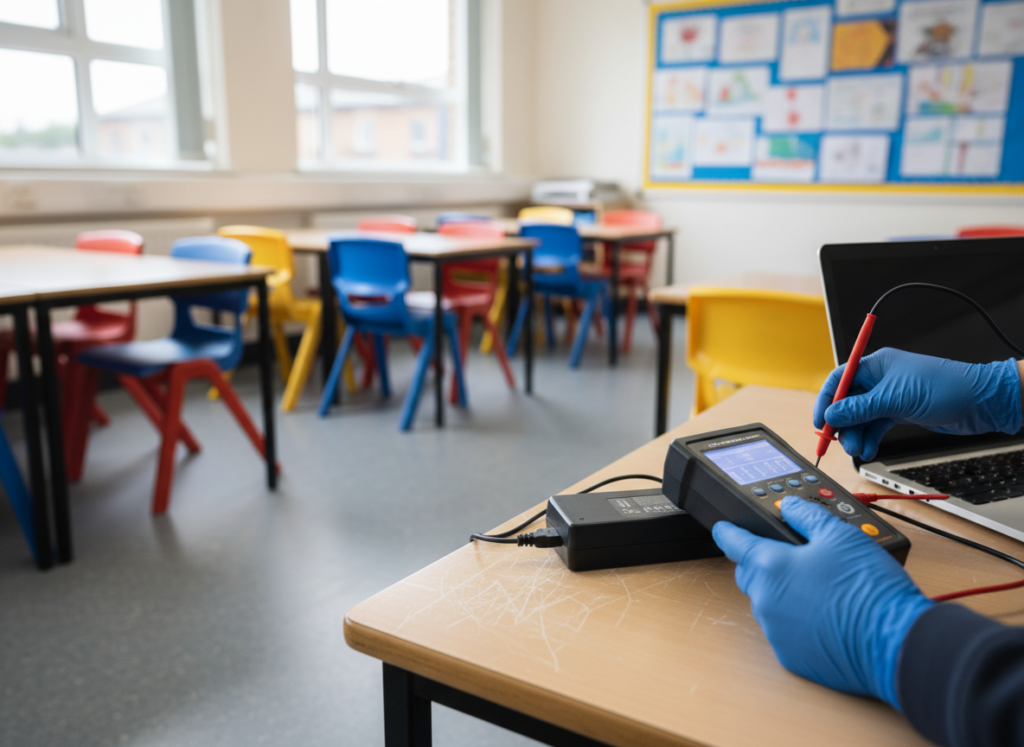
Why electrical safety in schools needs a planned approach
Electrical safety is easy to underestimate because most risks are hidden behind sockets, ceiling voids and distribution boards. In schools, the risk profile is higher than many workplaces because buildings are busy, equipment is moved frequently, and there are lots of temporary setups (extension leads, portable heaters, stage lighting, ICT trolleys, events).
For school leaders and trust teams, the goal is assurance: you need confidence that inspection and testing is planned, defects are fixed, and evidence is organised. For premises teams, the goal is practical control: spotting damage early, managing portable equipment safely, and ensuring contractors work to the right standard.
The legal picture (plain English)
Electrical safety duties in schools are mainly driven by:
- The Electricity at Work Regulations 1989 (duty to maintain electrical systems so they are safe)
- The Health and Safety at Work etc. Act 1974 (general duty to protect staff and others)
You do not usually comply by doing one test and filing it away. Compliance comes from a system: inspection/testing at appropriate intervals, competent contractors, and prompt remedial action.
Two key terms schools need to get right
EICR (Electrical Installation Condition Report)
An EICR is a formal inspection and test of the fixed electrical installation: distribution boards, wiring, sockets, lighting circuits and protective devices. It is carried out by a competent electrician and results in a report with observations coded by risk.
PAT (Portable Appliance Testing)
Portable Appliance Testing (PAT) is the inspection and testing of portable electrical equipment and leads (anything that can be moved and plugged in). PAT is not a legal requirement in itself, but it is a common way to demonstrate that portable equipment is maintained safely.
Start with your electrical risk picture
Before you set frequencies, map your risk:
- Building age and condition (older wiring, changes over time)
- High-use areas (ICT suites, kitchens, halls, caretakers stores)
- High-risk equipment (portable heaters, kettles, extension reels, stage/PA equipment)
- Who brings equipment in (staff, PTA, hirers, contractors)
- Any history of faults, tripping, overheating, or water ingress
This helps you justify testing intervals and prioritise remedials.
EICR: what it should cover and how to manage it
What an EICR includes (in practice)
A good EICR process will:
- Identify the scope clearly (which buildings/boards are included)
- Confirm the supply characteristics and earthing arrangements
- Inspect distribution boards, protective devices and circuit condition
- Test circuits (including RCD operation where present)
- Record observations and classify them by code
Understanding EICR codes (so you can act)
While exact coding depends on the electrician and standards used, schools typically see:
- C1: Danger present (immediate action required)
- C2: Potentially dangerous (urgent remedial action)
- C3: Improvement recommended
- FI: Further investigation required
For leaders: treat C1/C2/FI as governance-level items. You should be able to show what was done, when, and by whom.
How often should a school have an EICR?
There is no single interval that fits every school. Many schools plan EICRs on a periodic cycle (often several years) and adjust based on risk, building condition and previous findings. The important part is that your interval is justified and you can evidence ongoing maintenance.
Planning the EICR so it doesn’t disrupt learning
EICRs can require power isolation and access to rooms/ceiling voids. Plan:
- Access windows (holidays, INSET days, after school)
- Room access and keys
- IT shutdowns where needed
- Communication to staff about temporary outages
PAT: build a practical, risk-based programme
What should be in scope for PAT?
Typically include:
- Portable appliances (kettles, laminators, fans, portable heaters)
- ICT equipment and chargers (staff laptops, trolleys, interactive screens where applicable)
- Extension leads and multiway adaptors
- Equipment used for events (PA systems, stage lighting)
Decide how you handle personal devices and “bring your own” chargers — many schools either prohibit them or only allow them following a simple visual check.
Visual checks matter (and catch most issues)
A simple visual check process (by trained staff or premises team) should look for:
- Damaged plugs, cracked casings, loose pins
- Frayed cables, taped repairs, exposed wires
- Signs of overheating (discolouration, burning smell)
- Incorrect fuses or non-UK plugs/adaptors
PAT labelling and records
Avoid relying on labels alone. Your evidence should include:
- An asset list (unique ID, location, appliance type)
- Test date and outcome
- Next test due date (risk-based)
- Repair/replace actions taken
Common school issues (and how to control them)
Extension leads and adaptors
These are a frequent source of risk. Controls include:
- Avoid daisy-chaining multiway adaptors
- Use fixed sockets where possible (consider minor works to add outlets)
- Use extension reels correctly (fully unwind under load)
- Remove damaged or non-compliant adaptors immediately
Portable heaters
Portable heaters are high risk (fire and electrical). If you allow them:
- Use only approved models
- Keep clear space around them
- Prohibit use with extension leads unless specifically assessed
- Record where they are used and who authorised them
Kitchens, D&T rooms and practical areas
Higher risk due to heat, water, and heavy use. Ensure:
- Equipment is maintained and cleaned safely
- Isolators are accessible and labelled (without relying on small signage)
- Staff know how to isolate power in an emergency
Outdoor and temporary power
For events, site works and playground equipment:
- Use suitable outdoor-rated equipment
- Use RCD protection where appropriate
- Keep cables protected from trip/damage n
Contractor management: make it consistent
Electrical work should be controlled like any other compliance risk.
Your process should include:
- Competence checks (qualifications, insurance)
- Clear scope and method statement for works
- Isolation/lock-off procedures where needed
- ‘Make safe’ expectations at end-of-day (no exposed live parts)
- Handover documentation (certificates, test results)
For larger works, ensure you receive the correct certification (e.g., installation certificates) and file it with your compliance evidence.
What to evidence (audit-ready checklist)
Aim for one organised evidence trail that includes:
- Latest EICR(s) for each building/area and the schedule for the next cycle
- A remedial action log linked to EICR observations (owner, deadline, completion evidence)
- Certificates for any electrical installation works
- PAT inventory and test records (including extension leads)
- Records of visual checks (if you use them)
- Records of equipment removed from service and replaced
- Contractor competence/insurance records and job packs
- Any incident reports (shocks, overheating, repeated tripping) and outcomes
Practical tips that make you look ‘well run’
- Put EICR cycles, PAT rounds and remedial deadlines into your compliance calendar.
- Treat repeated tripping as a signal to investigate, not something to ‘reset’.
- Standardise extension leads and remove ‘random’ adaptors.
- Keep a small quarantine box for failed items so they don’t creep back into use.
- Audit a sample of classrooms each term for adaptors/heaters/charger clutter.
Useful links (UK guidance)
- HSE: Electricity at work – safe working practices: https://www.hse.gov.uk/electricity/
- HSE: Electricity at work regulations (overview): https://www.hse.gov.uk/electricity/faq.htm
- UK Government: Health and safety at work (overview): https://www.gov.uk/health-and-safety-at-work
Next step
If you want to strengthen electrical compliance quickly:
- Check when your last EICR was completed and whether remedials are fully closed out.
- Make sure extension leads and portable heaters are controlled.
- Confirm your PAT inventory is complete (including leads and chargers).
Then speak to a competent electrician/building consultant to confirm a risk-based testing plan that fits your buildings and term-time constraints.
Find trusted suppliers
Look for suppliers displaying the Education Supplier Badge

- Building Consultants: https://incensu.co.uk/single-category/building-consultants/
- Health & Safety: https://incensu.co.uk/single-category/health-and-safety/
- Facilities Management: https://incensu.co.uk/single-category/facilities-management/
FAQs
1) Is PAT testing a legal requirement in schools?
PAT itself is not a legal requirement, but schools must maintain electrical equipment so it is safe. PAT is a common way to evidence this.
2) How often should a school have an EICR?
There is no single interval that fits every school. Many schools use a periodic cycle and adjust based on risk, building condition and previous findings.
3) What should we do with failed PAT items?
Remove them from service immediately, label them clearly, and repair or replace through a controlled process.
4) What evidence should we keep for electrical compliance?
Keep EICRs, remedial action logs, installation certificates, PAT inventories and records, and contractor documentation.
Back to the hub
School Premises Compliance: Statutory Checks & Risk Management Hub https://incensu.co.uk/articles/school-premises-compliance-hub/
More guides in this hub